Jackalope
Douglas, Wyoming
Invented in 1932 by two brothers with a taxidermy shop. It has a licence.
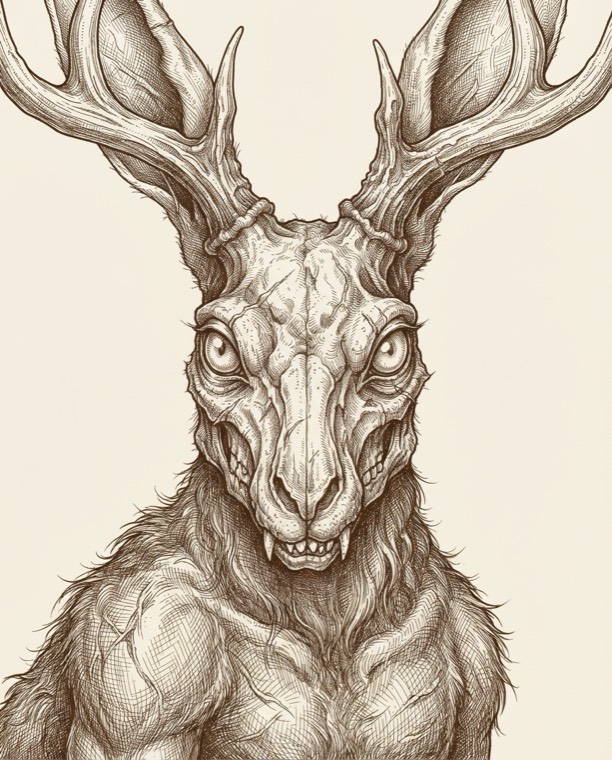
This is the only entry in the guide whose creator is known by name, and the Institute regards it as the most honest animal in the catalogue.
In or around 1932, Douglas Herrick and his brother Ralph, of Douglas, Wyoming, came back from hunting and tossed a jackrabbit carcass into their taxidermy shop, where it slid to a stop next to a set of deer antlers. They mounted the one on the other, sold the result to the La Bonte Hotel, and it hung in the lobby. Then they made more. Douglas Herrick died in 2003 and his obituary ran in the national press, which is a rare thing for the inventor of a monster.
The town committed completely. Douglas holds a trademark on the name, calls itself the Jackalope Capital of America, has an eight foot statue downtown, and its Chamber of Commerce issues official Jackalope hunting licences. The licence is valid for one hour, from midnight to two in the morning, on 31 June. There is no 31 June. Applicants must also certify an IQ of no more than seventy two.
Reported from
- Douglas, Converse County, Wyoming. The origin, the statue, the licence.
- Everywhere with a roadside bar between Cheyenne and Missoula. As mounted
taxidermy, in enormous numbers.
- Bavaria, as the wolpertinger, and across the German-speaking Alps. The same
joke, considerably older.
- The sixteenth and seventeenth century natural histories. The horned hare,
lepus cornutus, appears in serious European zoological works of the period, illustrated in good faith alongside animals that exist.
On the record
The part people find hard to believe is the true part. Horned rabbits are real.
Cottontails infected with Shope papillomavirus grow keratinous tumours from the head and face, often as branching horn-like structures, sometimes in exactly the place antlers would sit. It is a real disease with a real distribution across the American Midwest and West, and any rural taxidermist would have seen it.
It also matters far outside folklore. Richard Shope described the virus in 1933, one year after the Herricks made their mount, and the work that followed on it, particularly by Peyton Rous, established that a virus could cause cancer. That line of research runs directly to the modern understanding of human papillomavirus and to the HPV vaccine.
So the sequence is: a real disease produces genuinely horned rabbits, European naturalists document horned hares for centuries, two Wyoming brothers make a better one on purpose in 1932, and the virus behind the original goes on to teach medicine how viruses cause cancer.
The Institute lists the Jackalope as Documented. The documentation is a business licence.
Also in the guide: Mothman · Sasquatch · Chupacabra · Wendigo