Wendigo
the northern boreal forest
A serious tradition about famine, and the one entry in this guide that is not ours to play with.
The wendigo belongs to the Algonquian-speaking peoples of the northern forests and the subarctic, among them the Cree, the Anishinaabe, the Innu and the Naskapi. The word appears as wîhtikow, witiko, windigo and wetiko depending on the language and the transcription. It is not a monster in the sense that the rest of this guide uses the word. It is a moral and spiritual tradition about starvation, about the absolute taboo against eating human flesh, and about what unchecked appetite does to a person.
The core of it is this. In a winter that goes long enough, a person may become something that eats and is never filled. The wendigo is always described as starving in the middle of plenty. It is gaunt to the point of skeleton, enormously tall, with the smell of cold and decay, and the more it consumes the larger and hungrier it becomes. The Anishinaabe scholar Basil Johnston wrote about it as a figure of greed with a direct and unflattering application to how societies consume.
This is a living belief for living communities. It is not the Institute's material and this entry exists mainly to say so.
Where the tradition is held
- The Cree, Anishinaabe, Innu and Naskapi nations across the northern forest
and subarctic, in what is now Canada and the northern United States.
- Northern Minnesota, Wisconsin, Michigan and Ontario in the American and
Canadian record, though listing it by state is already a distortion. The tradition follows the people and the forest, not the border.
Two corrections the Institute insists on
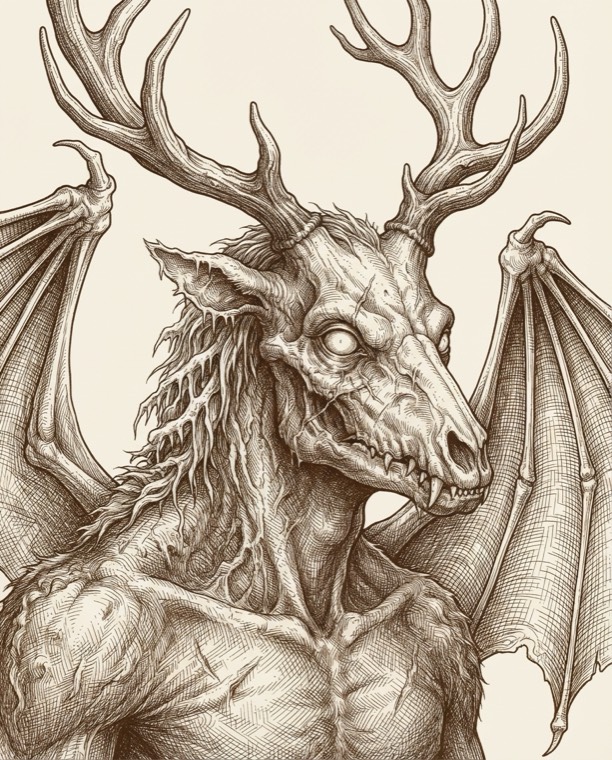
The antlered deer skull is modern fiction. The image that dominates search results, an emaciated humanoid with a cervid skull for a head and a rack of antlers, has no basis in Algonquian tradition. It is a twentieth and twenty first century entertainment invention, spread through games, television and concept art. Even Algernon Blackwood's 1910 story The Wendigo, which did more than anything else to move the word into non-Native fiction, has nothing of the kind. If you are picturing antlers, you are picturing an art director's work.
"Wendigo psychosis" is a contested colonial artefact. Older anthropological writing described a culture-bound syndrome in which sufferers were seized by a compulsion to eat human flesh. Later scholarship, notably Lou Marano's work in the early 1980s, argued the category was largely constructed by outside observers from a small number of cases involving famine, execution and translation error, rather than documented as a condition. Historical cases like that of Swift Runner, a Cree man executed at Fort Saskatchewan in 1879 after killing and eating his family in a winter of starvation, are real events, and the diagnosis laid over them afterwards is the part that does not hold.
The app will composite this figure into a photograph if you ask it to. It draws it as the tradition describes it, starved and grey and far too tall, and it will not draw it with antlers.
Every other entry in this guide is a story somebody told for fun. This one is a rule about what you must not do to survive the winter, and people kept it.
Also in the guide: Mothman · Sasquatch · Chupacabra · Jersey Devil