Fouke Monster
Boggy Creek, Arkansas
A night in May 1971, a low-budget film, and a three-toed print that has always been the problem.
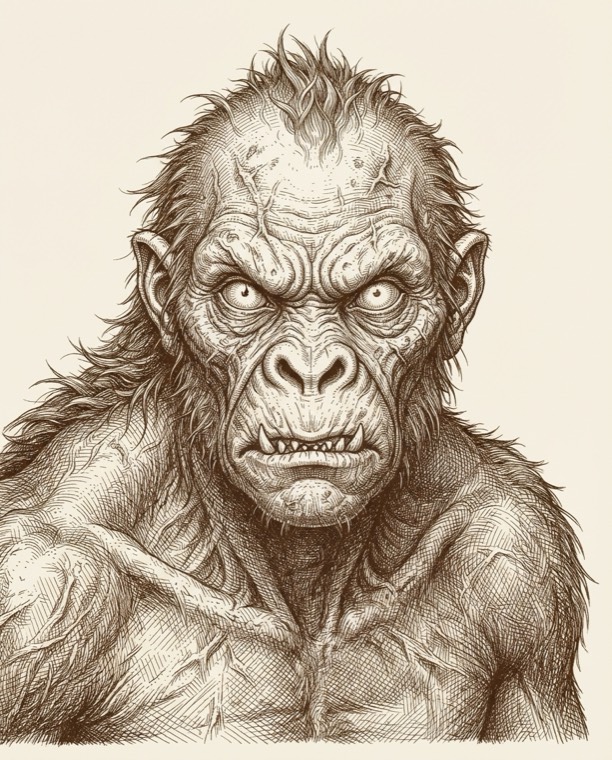
Fouke is a small town in Miller County in the far southwest corner of Arkansas, in the bottomland along Boggy Creek and the Sulphur River. It is thick country, flooded for part of the year, and by the standards of the lower forty eight it is genuinely difficult to walk through.
Accounts of a tall hair-covered animal in those bottoms go back at least to the 1940s, where they were known locally as the Jonesville Monster. The case broke on the night of 1 May 1971, at the home of Bobby and Elizabeth Ford, who had moved in days earlier. Elizabeth reported a hairy arm coming through a screen window. Later that night Bobby said he was attacked in the yard. He was treated at a Texarkana hospital for scratches across his back and for shock. The Texarkana Gazette carried it, the wire services picked it up, and for a summer the town filled with people carrying guns.
In 1972 a Texarkana advertising man named Charles B. Pierce made The Legend of Boggy Creek for somewhere around a hundred thousand dollars, using Fouke residents playing themselves. It is a docudrama, shot in a plain, patient, observational style with real locations and non-actors, and it made many millions of dollars. Its influence on the found-footage horror that followed, The Blair Witch Project included, is direct and widely acknowledged.
Reported from
- The Ford house on Jonesville Road, outside Fouke. The May 1971 incident.
- The Boggy Creek and Sulphur River bottoms, Miller County. The general range
in all accounts, before and since.
- Highway 71 south of Fouke. A sequence of roadside sightings through the
summer of 1971, several by drivers who did not know each other.
- Fouke itself. The monster is now the town's business, with a festival and a
museum in the old Monster Mart on Highway 71.
On the record
The tracks are the difficulty and the Institute will not soften it. Plaster casts taken from a soybean field near Fouke show three toes. Effectively every other North American ape-type report describes five. A three-toed print is not a variation on the pattern, it is a different animal, and the tracks were sufficiently doubted at the time that a local man was widely suspected of having made them. Prints were later shown to be fakes in at least one instance.
The 1971 injuries are better attested than the tracks. Bobby Ford was treated at a hospital and the record of that exists. What produced the scratches is not established, and a frightened man going through a screen window and a dark yard at speed is a complete explanation on its own.
The honest summary is that Fouke has a real 1971 incident involving real frightened people, a set of tracks that do not match anything else and are probably hoaxed, and a film that turned all of it into a permanent local economy.
The film is the artefact worth studying. It taught American horror that the most frightening thing you can point a camera at is an ordinary person, in an ordinary yard, telling you what happened to them.
Also in the guide: Mothman · Sasquatch · Chupacabra · Wendigo