Sasquatch
Bluff Creek, Northern California
Sasquatch is Halkomelem. Bigfoot came from a newspaper in 1958. The film is from October 20, 1967, and none of it has been resolved.
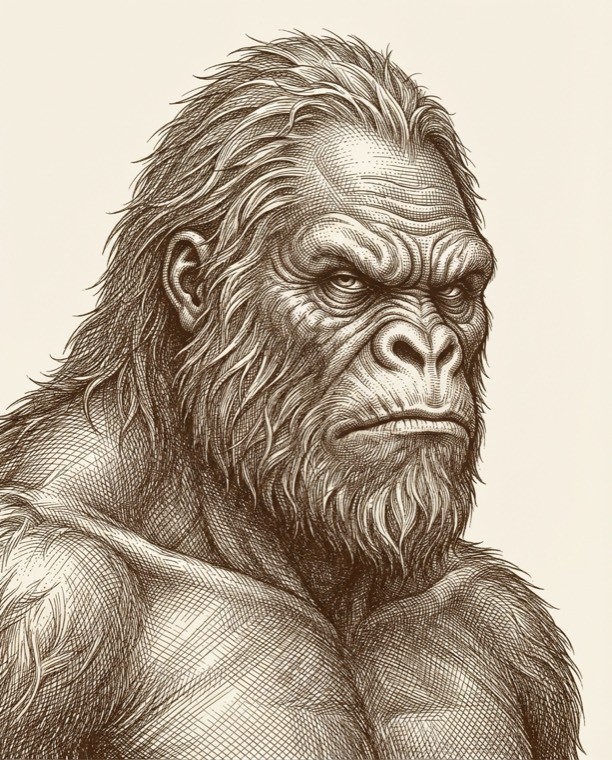
The word is not folklore in the loose sense. It is an anglicisation of sásq'ets from Halkomelem, a Salishan language of the Stó:lō people of the lower Fraser Valley, and it entered English in the 1920s through J.W. Burns, a teacher at the Chehalis reserve who collected accounts from the community and published them. The wild man of the mountains is a genuinely old and widely distributed figure across Pacific Northwest oral tradition, and it long predates anything a newspaper printed.
The other name arrived at Bluff Creek. In August 1958 a bulldozer operator named Jerry Crew found sixteen inch human-shaped tracks around his equipment on a logging road in Humboldt County, made a plaster cast, and took it to the Humboldt Times. The paper called the track maker Bigfoot. The story went national inside a fortnight.
Nine years later, on October 20, 1967, Roger Patterson and Bob Gimlin filmed fifty three seconds of 16mm colour footage on a sandbar on the same creek. The subject, universally called Patty, walks left to right across a gravel bar, turns her upper body toward the camera at frame 352, and goes into the trees. It is the most analysed piece of footage in the subject's history and it has never been resolved to general satisfaction, which is not the same as saying it is authentic.
Reported from
- Bluff Creek, Six Rivers National Forest, California. Both the 1958
trackway and the 1967 film. The specific sandbar has been altered by flooding and logging and is no longer identifiable with confidence.
- The Olympic Peninsula and the Cascade foothills, Washington. The densest
modern reporting anywhere in the country, and the Institute's own doorstep.
- Ape Canyon, Mount St. Helens. A 1924 account by a group of miners who said
their cabin was attacked overnight. Later claimed as a prank by a nearby youth camp, though not to everyone's satisfaction.
- Skamania County, Washington. Passed an ordinance in 1969 making the killing
of a sasquatch a felony. It was written partly in jest and has never been repealed.
On the record
Ray Wallace, the road contractor on the 1958 Bluff Creek job, died in 2002, and his family then produced a pair of carved wooden feet and said he had made the tracks. That claim is specific, credible and covers the trackway that produced the word Bigfoot. It does not cover the film, which his family did not claim.
The serious argument for the film has been about gait. Grover Krantz and later Jeff Meldrum at Idaho State argued that the subject shows a mid-tarsal break, a flexion in the middle of the foot that humans do not have and that was not understood in 1967, making it a strange thing to fake. The serious argument against is that a costume of that quality was achievable, that Patterson had a commercial motive and a film to sell, and that several people have claimed to have been in the suit without any of the claims standing up.
No specimen, no bones, no scat with unexplained DNA. Every hair sample submitted to a laboratory has come back as bear, elk, cow, dog or human. That is the state of it.
The most photographed decade in history to that point, and the best we have is fifty three seconds shot by a man who went looking for it.
Also in the guide: Mothman · Chupacabra · Wendigo · Jersey Devil