Roy Skaar and the King Octopus
Filed November 3, 1958 · Recorded by Lars Mikkelsen, Institute Founder
He had handled more octopus than he could count. That is the whole problem with what he measured.
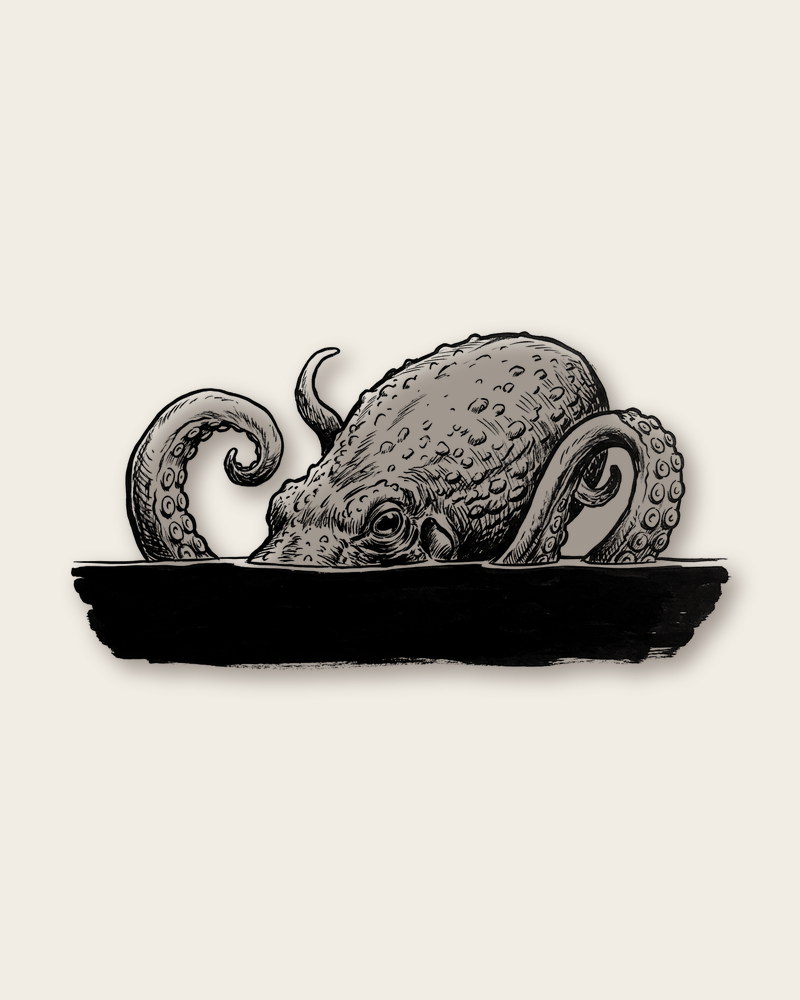
The Testimony
I have pulled crab pots out of Penn Cove since I was fourteen. My father did it before me and I did not choose it so much as end up in it. I say that so you know I am not a man who goes out on the water looking for anything.
You get octopus in the pots. Everybody does. They go in after the crab and they eat the crab and then they are too fat to get back out the tunnel, and you haul them up looking pleased with themselves. Most run twenty or thirty pounds. I pulled one once that went near ninety and it was a story at the dock for a week. You tip them over the side and down they go and that is that. It is not remarkable, it is Tuesday.
This was the third of November, 1958. First light, flat calm, fog sitting about as high as the wheelhouse. Cold enough that the lines were stiff in my hands.
The fourth pot came up wrong. Not heavy. Pots are heavy. This one was pulling. The line went off sideways under the boat and stayed there, and I stood on the rail and hauled against it for what I would call a minute and a half, which is a long time to pull against a thing that is pulling back.
Then it let go all at once and I sat down hard on the deck and the pot came up.
The laths were stove in along one side. Half inch cedar, pushed in the way a boot goes through a crate. There was no crab in it. There was no octopus in it either.
The boat rocked once the way it does when a swell comes under, and there was no swell that morning.
Something went down past the hull on the port side. I saw one arm of it. I was looking straight down into forty feet of water with the sun not up, and I saw an arm go down and away, and at the thick end, where it would join on to whatever it joined on to, it was about the size of my thigh.
I did not see the body. I want that written down. I saw an arm and I saw the dark it went into and I do not know how big the dark was.
Then it was quiet and I was standing on my own boat in the fog with a broken pot.
I will tell you what I did next because I have thought about it since. I did not start the engine and go in. I finished the string. Eleven more pots. I could not tell you why except that they were mine and they were out there.
At the dock I looked at the laths again and there were rings on them. Sucker marks. You see them on pots all the time and you do not think about it. These were on the outside of the pot. They were on the paint of the hull too, aft of the port chock, which I found when I was tying up.
I measured them because I measure things. I keep a log for the weights and the weather and where the string was set, and I wrote them in with the rest of that morning. The largest clean ring I could find was four and a quarter inches across. I measured it three times with a folding rule and I wrote down four and a quarter.
The ones I have seen my whole life run about two inches. Two and a half on a big one. I have never measured one over two and a half.
The marks were off the laths inside a week, which is what wet cedar does, and I painted the hull in the spring without thinking, which I have been sorry about ever since. What I have is the page. I did not show it to anybody for eleven years.
I am not telling you there is a monster in Penn Cove. I am telling you I know what an octopus is, I have handled more of them than I could count, and on the third of November 1958 I measured a sucker mark at four and a quarter inches.
Documentation Notes
Investigator: Lars Mikkelsen
Roy Skaar did not report this. That goes in the file first.
I have known Roy since before the Institute existed. In the autumn of 1969 I was at Coupeville about a boat and asked him how the herring had gone that year, and he told me, and then he sat for a while and said there was a thing he had never told anybody. It took him most of an hour and he stopped twice. He asked me not to write his name down and then said to go ahead and write it, and I have.
I took the account as he gave it and read it back to him twice.
The ordinary explanation, which is nearly all of this. Enteroctopus dofleini lives in this water in numbers and is the largest octopus there is. They raid pots constantly and every pot fisherman on the Sound has hauled one up. They are strong out of all proportion to their weight and a big one will stove in cedar without trouble. A thirty pound animal will beat a man's grip. Roy has landed one at ninety pounds himself and thought it worth a week of talk and nothing else.
Every part of his account is ordinary except one number.
The number. Sucker diameter goes with the size of the animal. The largest suckers on the largest specimens anybody has landed here run to about two and a half inches, which is what Roy has measured all his working life, and he has measured a great many. He recorded four and a quarter.
I have considered the following and I record them. A mark on cedar may spread as the wood dries. He may have taken two overlapping rings for one. A folding rule read three times in bad light at a dock in November is not a laboratory. And a man telling an eleven year old story may have improved it without meaning to, which is the one I take most seriously.
Against that: he wrote it down that morning, before it was a story, in the column where he writes the weather. The page exists and I have seen it. The hand matches the rest of the page and the ink matches, and the number sits between a wind direction and a count of crab.
What is established. A pot was crushed from the outside in Penn Cove on November 3, 1958. Something pulled against a hauled line for better than a minute and let go. There were sucker marks on the pot and on the hull and one of them was recorded at four and a quarter inches by a man with no reason to put a false number in his own log.
What is not. Everything else. He did not see the body. Neither have I, and I have worked this water since 1922.
On filing it at all. I would ordinarily refuse this. One witness, no trace left, and an animal we already have in the guide, which is the easiest kind of account to stretch. I have argued against filing better documented things than this and I expect to be asked about it.
I am filing it because the difference between the octopus we know and the one Roy describes is not a difference of kind. It is a difference of size. Size is a number and he wrote his down before he knew it was going to matter.
That is all this file is. A number in a crab log.
Filing. Class III. I have since taken three further accounts from pot fishermen working between Coupeville and Snatelum Point, all of them describing an animal larger than they could account for. None of them measured anything. Roy is the only one who went for a rule.
The creature in this account is catalogued in the field guide, and can be photographed in the app.